
Pilates Safety: 7 Simple Things That Help You Get More From Your Practice
Pilates can be a great way to build strength, improve movement and develop better body awareness. But one of the most important parts of Pilates is understanding that the same exercise doesn’t necessarily suit everyone in the same way.
Your experience, strength, mobility, previous injuries and even how your body is feeling that day can all influence how an exercise should be performed.
Here are some simple things that can help you get more from your Pilates sessions while keeping your practice safe and effective.
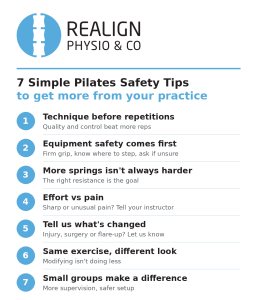
1. Good technique comes before more repetitions
It can be tempting to focus on completing every repetition, but Pilates is about quality and control.
If you’re losing control of the movement, holding your breath or compensating with another part of your body, it may be time to slow down or modify the exercise.
Sometimes, doing fewer repetitions with better control is far more beneficial than simply doing more.
2. Pay attention to the equipment — safety comes first
Pilates equipment allows us to perform a huge variety of exercises, but it also needs to be used correctly.
Small details can make a big difference to your safety. For example:
- When using the Cadillac/Tower, always make sure you have a firm grip on the bar when instructed, and never suddenly let go while the springs are under tension.
- When performing standing exercises on the Reformer, follow your instructor’s instructions about where to step. In many exercises, you should step onto the stable platform/board first rather than stepping directly onto the moving carriage.
- Make sure springs, straps, footbars and other equipment are correctly positioned before beginning an exercise.
- Don’t move or adjust equipment under tension unless you have been shown how to do so safely.
These might seem like small details, but they are an important part of learning Pilates.
Your instructor should explain how to use the equipment safely, and if you’re ever unsure, stop and ask before continuing.
3. More springs don’t always mean a harder exercise
It’s easy to assume that adding more springs automatically makes an exercise more challenging. But that’s not always the case.
Depending on the exercise, using fewer springs can actually make it significantly more challenging because you may have less assistance or stability from the equipment.
For example, changing the spring resistance can alter how much control, balance or strength you need to perform a movement.
That’s why your instructor may give you a different spring setting from someone else — or even change your springs during the same exercise.
The goal isn’t to use the most springs or the least springs. The goal is to use the right amount of resistance for the exercise and for you.
4. Learn to recognise the difference between effort and pain
It’s normal to feel your muscles working during Pilates. You may feel fatigue, effort or a gentle stretch.
However, sharp, pinching, sudden or unusual pain shouldn’t simply be pushed through.
If something doesn’t feel right, let your instructor know. An exercise may need a small adjustment, a different setup or a completely different variation.
5. Let your instructor know when something has changed
Your instructor can’t see everything you’re experiencing.
If you’ve recently had an injury, surgery, experienced a flare-up of an existing condition, or simply feel different from usual, let them know before starting your session.
Even something that seems unrelated to Pilates can be important when deciding which movements are appropriate for you that day.
6. The same exercise can look different from person to person
One of the benefits of Pilates is that exercises can be adapted.
A bridge, roll-down, plank or standing exercise doesn’t have to look exactly the same for everyone. An instructor may change the range of movement, resistance, position or even choose a different exercise to achieve the same goal.
Modifying an exercise isn’t “doing less”. It’s choosing the version that is right for your body at that moment.
7. Why a small group can make a big difference
Pilates isn’t only about the exercises you do — it’s also about the supervision and individual attention you receive while doing them.
In a large class, it can be difficult for one instructor to observe everyone’s technique, equipment setup and movement quality at the same time.
In a smaller group, the instructor can pay closer attention to each person and make adjustments when needed — whether that’s changing a spring, correcting positioning, modifying an exercise or helping you use the equipment safely.
This is particularly valuable for people who are new to Pilates, returning after an injury or working with specific movement limitations.
At Realign, our Pilates classes are semi-private Studio Pilates sessions
At Realign, our Studio Pilates sessions are designed as semi-private sessions with a small number of participants, rather than large reformer group classes.
This allows our instructors to work more closely with each person and adapt exercises according to their individual needs, experience and goals.
Our Studio Pilates sessions use a range of Pilates equipment, including the Reformer, Cadillac, Wunda Chair, Barrel and other studio equipment, rather than focusing only on Reformer exercises.
This approach allows Pilates to be more individualised and gives the instructor more opportunities to adapt the session to the people in front of them.
Pilates isn’t one-size-fits-all
Good Pilates isn’t about everyone in the room performing identical movements.
It’s about understanding the purpose of an exercise and knowing how it can be adapted to the person performing it.
An instructor who understands movement and individual limitations can help identify when an exercise should be progressed, modified or replaced — and can also make sure you’re using the equipment safely.
So next time your instructor changes your spring, adjusts your position or gives you a different version of an exercise, remember: it’s not necessarily because you’re doing something wrong. It may simply be because your body needs something different.
The goal is not just to complete an exercise.
It’s to move well, build confidence and make Pilates work for you.